
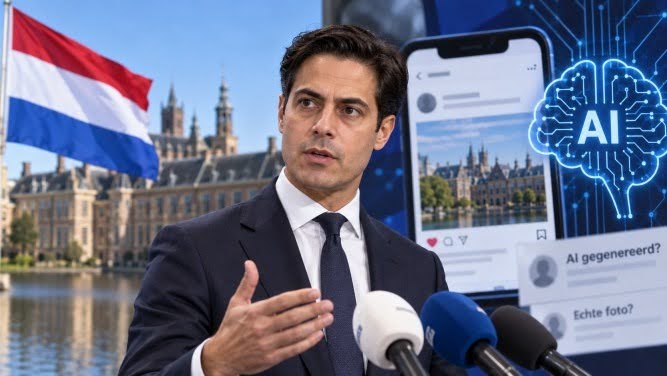
The Dutch political landscape has been stirred by revelations that Prime Minister Rob Jetten and his D66 party have utilized artificial intelligence to craft a considerable number of their social media posts. This approach, particularly on sensitive political topics, has ignited discussions about the authenticity of these communications and the potential erosion of public trust. An extensive analysis of 1,812 posts from Jetten’s and D66’s accounts on platforms like X, Instagram, Facebook, and LinkedIn since 2021 uncovered that at least 232 posts were AI-generated. Of these, 68 posts were linked to Jetten’s personal accounts and the remaining 164 to the party’s profiles.
The analysis further highlighted a notable surge in AI-generated content following the collapse of the Schoof I Cabinet in June 2025, with approximately 30% of posts thereafter being identified as AI-produced. This technology was not only employed in social media posts but also played a role in composing parts of Jetten’s book “Hoe het wél kan” and in scripting lines for three D66 campaign videos. The use of AI in such politically sensitive contexts, including discussions on the Ukraine war, the MH17 disaster commemoration, and the Dutch government’s apology to the Moluccan community, has drawn significant scrutiny.
D66 has admitted to leveraging AI in their communications strategy but reassures that all content undergoes review and refinement by their staff. They insist that posts on Jetten’s personal accounts are based on his input and receive his approval or edits before publication. Despite these assurances, questions linger about the implications of presenting AI-generated content as personal communication, with experts warning of potential challenges to distinguishing genuine political views from computer-generated messaging.
Professor Claes de Vreese of the University of Amsterdam has voiced concerns that AI-generated language might undermine the credibility of politicians like Jetten, as it becomes increasingly difficult for the public to discern authentic views. The controversy underscores broader issues regarding transparency and the ethical use of AI in political communication, especially when constituents expect social media accounts to echo the true words and thoughts of their elected officials.